Last Friday, I attended the party to mark the closure of the Boston Globe bureau at which I completed my third and final co-op. The Globe NorthWest section, after a move from a cramped office on Marrett Road to a spacious and bright office on Hayden Ave, will now be divided between the Globe North and the Globe West bureaus.
This is a short photoessay I've constructed:
The photos can be viewed in a full-size slideshow here.
Monday, March 30, 2009


Saturday, March 07, 2009
Things to Tend To

Like a novice craps shooter, I'm moving into hedge-your-bets territory with this job search. In addition to keeping options open in PR or business communications, I'm starting to expect to make a substantial amount of my income through my new trade: bartending. Yesterday I finished up my course at DrinkMaster Bartending School, which means I'm pretty well-trained and qualified to make an Absolut Sex on the Beach, straight-up, rocks on the side.
But that means I've also got to start another job search; I've got to find someone to hire me to work as a bartender part-time while I'm still in school (and maybe more after I graduate until I find something in my field). Remake the resume entirely, emphasizing a whole new skill set that has nothing to do with the written word.
(Also: I love that the instructor of the class confirmed what I've always suspected. People are dumb.)
From time to time, I wonder if I wouldn't have been better off studying something else - there's just seemingly nothing out there. Yeah, I know that's not true, very cynical, blah blah blah. But try convincing college seniors (especially those in the liberal arts majors) of that. Myself included. I bet I'll have an easier time convincing someone to pay me to make a round of Blue Kamikaze shots than I will convincing them to pay me to report on the decline of science fairs throughout MetroWest. Even worse? I think I'd probably make more money bartending than I would at an entry-level journalism job.
Photo is mine from Boston in 60 Project.
Thursday, February 19, 2009
Fool me once, shame on you. Fool me thrice, I'm gonna be pissed.
Just walked back in from an extremely abbreviated visit to the Isabella Stewart Gardner Museum. Given I've been killing myself the last week to get assignments for other classes done, I had been forced to put off this week's photojournalism assignment (candid shots at a planned event), I was going to head over there tonight to shoot their regular Thursday night cocktail hour. Figured I'd get a couple shots in about 45 minutes and get out of there before I got suckered into buying some expensive drink.
This is three times now, though, that the ISG has screwed me over, and only one of them was my own damn fault.
Sometime when I was younger, my family packed up the SUV to go check out the ISG. We'd been hearing good things about it forever, and my folks figured we could get in and out pretty quickly, before my brother (who was all of 7 at the time) or sister (who would have been 3) started to complain. At some point during the trip, my brother apparently leaned too far over a display and one of the security guards threw a hissyfit, manhandled my brother away from the display, and yelled at him right there. He was 7. He hadn't fallen, he just got closer than the security guard liked.
During the summer, while I was working on my Boston in 60 Project, I decided some Monday morning to go to the Gardner museum for my daily trip. I hadn't checked ahead of time; it's not open on Mondays. Of all the days of the week for it to be closed, that didn't make sense to me, but fine, I'll chalk that one up to my own damn fault.
This time, though, I had done my due diligence. I scoured the ISG website (to which I refuse to link) and found no mention of a ban on photography. Great - I'd swallow my pride, get my shots, and get out of there. So I headed over to the museum around 6:15 for an event that ran from 5:30-9:30. After waiting in line for half an hour in the 35-degree drizzle, I finally got into the foyer where I was told "no photography, you'll have to check that". I asked the guy why not, was this not just a regular Thursday night event? "Museum rules." Then I cursed him out colorfully in front of the whole line and walked away. If someone can find any mention of a ban on photography on the ISG website, I'll take my crow pie, but I looked and there was nothing.
So now, with this assignment due tomorrow morning, I have just about no chance to get anything. Thanks, Isabella, and rot in hell!
This is three times now, though, that the ISG has screwed me over, and only one of them was my own damn fault.
Sometime when I was younger, my family packed up the SUV to go check out the ISG. We'd been hearing good things about it forever, and my folks figured we could get in and out pretty quickly, before my brother (who was all of 7 at the time) or sister (who would have been 3) started to complain. At some point during the trip, my brother apparently leaned too far over a display and one of the security guards threw a hissyfit, manhandled my brother away from the display, and yelled at him right there. He was 7. He hadn't fallen, he just got closer than the security guard liked.
During the summer, while I was working on my Boston in 60 Project, I decided some Monday morning to go to the Gardner museum for my daily trip. I hadn't checked ahead of time; it's not open on Mondays. Of all the days of the week for it to be closed, that didn't make sense to me, but fine, I'll chalk that one up to my own damn fault.
This time, though, I had done my due diligence. I scoured the ISG website (to which I refuse to link) and found no mention of a ban on photography. Great - I'd swallow my pride, get my shots, and get out of there. So I headed over to the museum around 6:15 for an event that ran from 5:30-9:30. After waiting in line for half an hour in the 35-degree drizzle, I finally got into the foyer where I was told "no photography, you'll have to check that". I asked the guy why not, was this not just a regular Thursday night event? "Museum rules." Then I cursed him out colorfully in front of the whole line and walked away. If someone can find any mention of a ban on photography on the ISG website, I'll take my crow pie, but I looked and there was nothing.
So now, with this assignment due tomorrow morning, I have just about no chance to get anything. Thanks, Isabella, and rot in hell!
Wednesday, February 18, 2009
What we have here is a failure to communicate.
We've all heard the expression "addition by subtraction" used, frequently in reference to sports teams. But this past week, I wonder if I didn't encounter my first genuine example of "subtraction by addition".
I'm an ardent and lifelong supporter of the New England Revolution. Stuck it out through some crappy years, and more pertinent to this post, some crappy marketing campaigns to accompany the crappy years. Those of us in the fandom recall vividly the "Get Your Kicks" campaign (gag).
For the majority of the team's existence, the front office has chosen to market itself almost exclusively to the soccer moms/youth teams demographic. I can't fault them on this - in theory, a family of five is going to spend more at a game than five 20-somethings. I thought the campaigns were cheesy and more than a little annoying, but they kept at it for a good few years.
In recent times, however, with the team's sustained success and growing (and vocal) diehards' groups, the team has started to market to that 20-something male demographic with images like this one:

In case you can't read the fine print: "The Fort experience is not intended for children nor is it for the faint of heart. So grab your scarf and warm up your vocal chords and get ready for the most raucous experience in New England sports!"
Definitely a step in the right direction, as far as the diehards like myself saw it. This was an ad campaign that would appeal to the soccer fanatics, the 20-somethings with disposable income (that season ticket works out to $10/game), and wouldn't put off the soccer families that sit on the other side of the stadium.
But last week, the team issued an audition call for its new "street team", the Rev Girls:
Sending out 10 or 12 B-rate cheerleaders to the local Uno's is neither going to increase ticket sales, nor is it more than a token "we're trying" when it comes to word-of-mouth. And even if the street team does experience some modicum of success, it's completely unquantifiable - you can count how many people use free vouchers, but the team isn't making any money on them. And if it's not vouchers - you've got nothing to show that the street team's work has had any effect.
Word-of-mouth marketing doesn't need to be complex, nor does it need to be contrived, nor does it need to pander so blatantly to one demographic at the exclusion of others. How many soccer moms are going to bring little Suzy Kicksalot and her U-12 teammates when the "tits 'n kits" team are strolling through the concourse? How about if they meet the street team at their local restaurant? Is soccer mom Kicksalot going to be interested in going to a game when the promotional group is wearing two-pieces and and a push-up? Not to mention that the people they want this program to reach aren't going to respond to a couple of tchotchkes handed to them. They'll show up at a soccer bar, start plugging the Revs, and get shouted down by the guys watching the English leagues on TV.
It's this simple: college outreach. I proposed a college outreach program in my full-throated attack on this "street team" nonsense on BigSoccer. It's not all that difficult to envision. Contact each of the colleges within, say, a hundred miles of Gillette Stadium. Offer $15 ticket-bus-and-personal-pizza vouchers to the students, one bus per college. Don't do it all on one night, do it throughout the season. Each week, a dozen or so schools are sending buses full of tabula-rasa-brand-advocates. Each school could do more than one game - although much of the Revs season falls during the summer break, there are a handful of games before and certainly high-level games after.
Get butts in the seats. Give them a quality product, a good time, and an easy trip to and from the venue, and you'll have several thousand new Revs fans who want to come back. You can't fall in love with the local team on TV, you have to do it in person. New England Revolution holds the monopoly on live men's soccer, and yet they do nothing to market this. They need to get out there and demonstrate that we have a supporters section like their favorite European teams do, but the only way to grow that is to become a part of it.
What's more - all of this, the college outreach, the immigrant outreach, this can all be done without running the risk of alienating soccer mom Kicksalot. Throwing some full-chested bimbos at a bar and calling it "word-of-mouth" marketing is a failure both to maintain the audience you have and to reach the audience you want. It's a pathetic display of "sex sells, ergo, we need sex", and it's a step backward from the excellent "Defend the Fort" campaign.
I'm an ardent and lifelong supporter of the New England Revolution. Stuck it out through some crappy years, and more pertinent to this post, some crappy marketing campaigns to accompany the crappy years. Those of us in the fandom recall vividly the "Get Your Kicks" campaign (gag).
For the majority of the team's existence, the front office has chosen to market itself almost exclusively to the soccer moms/youth teams demographic. I can't fault them on this - in theory, a family of five is going to spend more at a game than five 20-somethings. I thought the campaigns were cheesy and more than a little annoying, but they kept at it for a good few years.
In recent times, however, with the team's sustained success and growing (and vocal) diehards' groups, the team has started to market to that 20-something male demographic with images like this one:

In case you can't read the fine print: "The Fort experience is not intended for children nor is it for the faint of heart. So grab your scarf and warm up your vocal chords and get ready for the most raucous experience in New England sports!"
Definitely a step in the right direction, as far as the diehards like myself saw it. This was an ad campaign that would appeal to the soccer fanatics, the 20-somethings with disposable income (that season ticket works out to $10/game), and wouldn't put off the soccer families that sit on the other side of the stadium.
But last week, the team issued an audition call for its new "street team", the Rev Girls:
The New England Revolution will hold interviews for the Rev Girls, the Revolution’s new promotional squad, at 10 a.m. in the East Fidelity Investments Clubhouse at Gillette Stadium on Saturday, Feb. 21.This is an appalling display from the team on several different fronts. Not only is it chauvinistic to a degree we haven't seen from Kraft Sports Group before ("form-fitting clothing", "no facilities available to prepare", "the hottest promotional group in town"), it's also an extremely poorly-constructed attempt at grassroots marketing.The team’s newest marketing initiative, the Rev Girls will run promotions at games and nighttime events and make public appearances on behalf of the team.
Women interested in interviewing for a roster spot with the Rev Girls must be at least 21 years old, and must bring positive identification with them. Prospective team members must also wear form-fitting clothing to the interview, and also bring both a headshot and a full-body image. Successful candidates will also be available for the entire duration of the Revolution season – March through November.
Those interviewing for a Rev Girl spot should come dressed and ready to meet the staff. There will no facilities available to prepare for the interview.
Sending out 10 or 12 B-rate cheerleaders to the local Uno's is neither going to increase ticket sales, nor is it more than a token "we're trying" when it comes to word-of-mouth. And even if the street team does experience some modicum of success, it's completely unquantifiable - you can count how many people use free vouchers, but the team isn't making any money on them. And if it's not vouchers - you've got nothing to show that the street team's work has had any effect.
Word-of-mouth marketing doesn't need to be complex, nor does it need to be contrived, nor does it need to pander so blatantly to one demographic at the exclusion of others. How many soccer moms are going to bring little Suzy Kicksalot and her U-12 teammates when the "tits 'n kits" team are strolling through the concourse? How about if they meet the street team at their local restaurant? Is soccer mom Kicksalot going to be interested in going to a game when the promotional group is wearing two-pieces and and a push-up? Not to mention that the people they want this program to reach aren't going to respond to a couple of tchotchkes handed to them. They'll show up at a soccer bar, start plugging the Revs, and get shouted down by the guys watching the English leagues on TV.
It's this simple: college outreach. I proposed a college outreach program in my full-throated attack on this "street team" nonsense on BigSoccer. It's not all that difficult to envision. Contact each of the colleges within, say, a hundred miles of Gillette Stadium. Offer $15 ticket-bus-and-personal-pizza vouchers to the students, one bus per college. Don't do it all on one night, do it throughout the season. Each week, a dozen or so schools are sending buses full of tabula-rasa-brand-advocates. Each school could do more than one game - although much of the Revs season falls during the summer break, there are a handful of games before and certainly high-level games after.
Get butts in the seats. Give them a quality product, a good time, and an easy trip to and from the venue, and you'll have several thousand new Revs fans who want to come back. You can't fall in love with the local team on TV, you have to do it in person. New England Revolution holds the monopoly on live men's soccer, and yet they do nothing to market this. They need to get out there and demonstrate that we have a supporters section like their favorite European teams do, but the only way to grow that is to become a part of it.
What's more - all of this, the college outreach, the immigrant outreach, this can all be done without running the risk of alienating soccer mom Kicksalot. Throwing some full-chested bimbos at a bar and calling it "word-of-mouth" marketing is a failure both to maintain the audience you have and to reach the audience you want. It's a pathetic display of "sex sells, ergo, we need sex", and it's a step backward from the excellent "Defend the Fort" campaign.
Monday, February 09, 2009
Career Fair Wrap
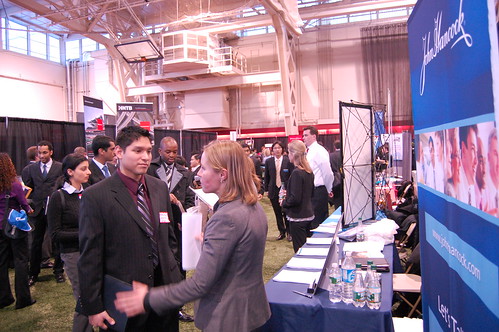
Bugger. I went through all that effort to print out and collate clips, buy and stuff folders, update and copy my resume, and practice my elevator pitch, and there was nothing there for me at the career fair last week. I know the industry's going through a rough redesign and identity crisis, but I had hoped there'd be at least a few more jobs tangentially related to journalism there. Even the PR and marketing segments were under-represented.
I suppose, on the bright side, that going to a career fair where there was little for me offered me a dress rehearsal of sorts - I got to interact with HR managers and recruiters without any of the pressure of an actual job being on the line.
Moral victories.
Flickr photo is mine.
Tuesday, February 03, 2009
The moat is gone.
This Thursday, I'm heading to my first career fair here at Northeastern. I've had my resume looked at a few times, I'm going to print up some clip folders to take with me, and I'm going home to get my suit tomorrow. But there's at least one thing I'm missing in my sell-yourself toolkit: the elevator pitch.
For each of my co-ops and internships, I've been able to use my clipbook as a moat of sorts. The people in charge take a look at what I've done, and only if they think I can handle the job do they call me in for an interview. By that point, I had one foot in the position already - I'm gathering that there aren't all that many applicants for the regionals at the Globe (although if these kids knew anything, that'd be top of their list). The interview itself was usually "tell me about yourself, tell me about your experience in journalism," and then, "this is what the job requires."
I've got to start from scratch now without that moat - the clipbook won't come into the equation until after first contact, and it's that first contact that is intimidating me a little bit now. I've never had to make an elevator pitch. I have absolutely no idea how I would go about it. "Hi, I'm Adam, I've been writing for newspapers for 7 years, and I've got a good handle on some social media"? That doesn't sound good at all.
How on Earth do I do this?
For each of my co-ops and internships, I've been able to use my clipbook as a moat of sorts. The people in charge take a look at what I've done, and only if they think I can handle the job do they call me in for an interview. By that point, I had one foot in the position already - I'm gathering that there aren't all that many applicants for the regionals at the Globe (although if these kids knew anything, that'd be top of their list). The interview itself was usually "tell me about yourself, tell me about your experience in journalism," and then, "this is what the job requires."
I've got to start from scratch now without that moat - the clipbook won't come into the equation until after first contact, and it's that first contact that is intimidating me a little bit now. I've never had to make an elevator pitch. I have absolutely no idea how I would go about it. "Hi, I'm Adam, I've been writing for newspapers for 7 years, and I've got a good handle on some social media"? That doesn't sound good at all.
How on Earth do I do this?
Wednesday, January 28, 2009
Tweets as quotes?
In the not-so-distant past, I remember being outraged when one traditional media outlet or another quoted from someone's Facebook wall for a story. It usually happened after a student's untimely death (look about 12 grafs down), and the TV stations would dig up the flood of condolence messages left on the student's wall in the aftermath and report them. Easy, low-labor quotes for color. I was upset, however, that the traditional media I respected so much would stoop to taking quotes not given to a media member or intended for consumption by many and reuse it for their own purposes.
In time, however, I came to accept that this is not just the reality of how we're to find commentary, it's also valid journalistically. These quotes are not provided to the media, but if we can access them as easily as typing in a URL, they're fair game. Students know by this point that anything they say online is completely out in the open, and the newspaper can be no exception to that. The problem remains, though, that if I quote Jack Ripper's wall post, I've got no way of knowing that Jack Ripper is a real person, or that Jack Ripper himself wrote the wall post. Especially now that Facebook is open to anybody with an email address and not just an @.edu address, additional avatars beyond your actual name are easy to create and play with. (For example, my own mother wanted to explore Facebook, but instead of creating a page for herself, she created one for the dog.)
As a result, journalists still need to take with a grain of salt the use of many (if not most) social networking sites for quotes. But this raises the question as to whether there are degrees of acceptability in social network quotation. If a Facebook user's name is "Jack Ripper" and their listed email is, in fact, an @.edu address, does that make it more likely that Jack Ripper is legitimate? Does that likelihood decrease if the listed email is @.hotmail or @.gmail?
And then there's the application of that same principle to other social networking sites. An old editor of mine wrote me a brief recommendation on LinkedIn, but had to retract it when he decided that if he was going to use LinkedIn as a source, he could not be in the business of recommending people. I understand that fully, it's a conflict-of-interest if he were to endorse me and then use the same network to dig up information for an investigative article. I'm inclined to believe LinkedIn would be of greater validity for the purposes of quotation than Facebook or MySpace, but there's such less availability for usable quotes in LinkedIn that this advantage is meaningless.
But what about Twitter? I'm subscribed to the "official" Twitter feed for Gov. Deval Patrick. If I ask him a question on Twitter and he responds, can I use that as a quote? Does it become a story if what Gov. Patrick (or any other "official" feed) says does not mesh with what he/she says publicly or when asked for comment by a reporter? And do the rules change when a social media "celebrity" is involved? Say I want to quote Chris Brogan in an article I'm writing. Now, Chris is a big proponent of social media, but does that give me permission to quote his blog or a Tweet of his? After all, it's similar to the Facebook-wall-quote grab: once it's online, it's in the public domain.
I suspect that there is not yet any sort of code for how traditional media can exploit social media in this manner. Scouring Facebook or Twitter for sources to then call up personally is obviously fair game, but I wonder what an editor would say if I turned in an article quoting a Tweet.
In time, however, I came to accept that this is not just the reality of how we're to find commentary, it's also valid journalistically. These quotes are not provided to the media, but if we can access them as easily as typing in a URL, they're fair game. Students know by this point that anything they say online is completely out in the open, and the newspaper can be no exception to that. The problem remains, though, that if I quote Jack Ripper's wall post, I've got no way of knowing that Jack Ripper is a real person, or that Jack Ripper himself wrote the wall post. Especially now that Facebook is open to anybody with an email address and not just an @.edu address, additional avatars beyond your actual name are easy to create and play with. (For example, my own mother wanted to explore Facebook, but instead of creating a page for herself, she created one for the dog.)
As a result, journalists still need to take with a grain of salt the use of many (if not most) social networking sites for quotes. But this raises the question as to whether there are degrees of acceptability in social network quotation. If a Facebook user's name is "Jack Ripper" and their listed email is, in fact, an @.edu address, does that make it more likely that Jack Ripper is legitimate? Does that likelihood decrease if the listed email is @.hotmail or @.gmail?
And then there's the application of that same principle to other social networking sites. An old editor of mine wrote me a brief recommendation on LinkedIn, but had to retract it when he decided that if he was going to use LinkedIn as a source, he could not be in the business of recommending people. I understand that fully, it's a conflict-of-interest if he were to endorse me and then use the same network to dig up information for an investigative article. I'm inclined to believe LinkedIn would be of greater validity for the purposes of quotation than Facebook or MySpace, but there's such less availability for usable quotes in LinkedIn that this advantage is meaningless.
But what about Twitter? I'm subscribed to the "official" Twitter feed for Gov. Deval Patrick. If I ask him a question on Twitter and he responds, can I use that as a quote? Does it become a story if what Gov. Patrick (or any other "official" feed) says does not mesh with what he/she says publicly or when asked for comment by a reporter? And do the rules change when a social media "celebrity" is involved? Say I want to quote Chris Brogan in an article I'm writing. Now, Chris is a big proponent of social media, but does that give me permission to quote his blog or a Tweet of his? After all, it's similar to the Facebook-wall-quote grab: once it's online, it's in the public domain.
I suspect that there is not yet any sort of code for how traditional media can exploit social media in this manner. Scouring Facebook or Twitter for sources to then call up personally is obviously fair game, but I wonder what an editor would say if I turned in an article quoting a Tweet.
Monday, January 19, 2009
Adam of all Trades

Considering it's my last semester here at Northeastern, I picked my classes with an eye to studying what I'm interested in instead of what I thought I had to study. Consequently, I'm taking French for the first time in six years, I'm taking a microeconomics course (in no small part to re-brainwash me from the libertarian perspective of the course in Washington) and I'm taking a photojournalism course.
The first meeting of that course presented us with an interesting question: why are we taking it? Something like 75% of the class answered, "because I like journalism and I like photography". A fair answer; I'm not going to argue that they're wrong. I just happened to take a more pragmatic approach to the question:
"Because I know that given the industry's trajectory, if I can't take a half-decent picture, I'm not getting a job."
For whatever it's worth, the professor has mentioned that response two or three times since. Apparently the cynicism and pragmatism of knowing you need to have every tool you can in your toolkit has become an almost laudable awareness. But I look at the hoops I'm jumping through to attain those tools and I wonder just how many of them I'm going to need and which ones will prove to be the useful ones. I can already claim a familiarity with video production and editing, podcasting, various forms of social/new media, the processes for writing and editing a story to work for both online and print...but it's not enough, apparently. You have to be a one-man media unit in order to even dream of success in this new age.
Ironic, isn't it, that I maintain one foot firmly in the camp of traditional media while simultaneously doing all I can to ready myself to replace those who remain there?
Image courtesy of Flickr user rolands.lakis.
Monday, January 12, 2009
Unexpected.

The other night I attended my sister's middle school performance of Les Miserables. I will admit that I was very apprehensive before sitting down; it's an epic musical and the most recent production of the school's had bored me. I was concerned that a bunch of 7th-graders would fail to do even remote justice to the beauty that is the story of Les Miserables.
I was surprised, then, that they rose to the challenge. Sure, there were parts that weren't great, but it was substantially better than I anticipated it being. It was an unexpected success.
That word, though. "Unexpected". I'd classify a lot of what is going on at the moment as "unexpected." On the positive, meeting Conor was unexpected. Being in DC for the election (and having it go the way I wanted) was unexpected.
However, it goes both ways. For example, I've got a phone call tomorrow to see if a particular job application I put in did me any good. It was somehow unexpected that I've not heard from the company in question since I sent in my resume and cover letter before the new year. I had such excellent luck in getting the jobs I wanted for co-ops and internships that the potential failure to get that first "good job" I found would be unexpected. I don't want to have to cross it off and move on, I liked what I saw as an entry-level job that paid pretty well, but that's a very distinct possibility come tomorrow.
I suppose that boils down to what some friends of mine have already discovered: "the job search sucks". It's not as though everything I wanted with respect to workplaces was given to me; I like to think I earned it. But in being conditioned to experience success when I decided I wanted it, I have to gear myself up more than might be normal for failure so as not to let it be discouraging.
Image courtesy of Flickr user eole.
Monday, January 05, 2009
A Boston "Dumbocrap"

A couple of things happened when I returned from Washington a couple of weeks ago: one, I got to see more people of my own particular political ideology (most of the people in my DC program were markedly conservative); and two, I returned to working part-time at the Globe. I got a bit of a when-worlds-collide moment when a recent City Desk shift showed me an angry letter that was sent to the Globe. In part:
...you gay Marxist atheists at the Globe are really afraid of a small woman from the real world taking out the holy one, Half-Black Mohammed Islamobama and his anti-change partner, White Bread Joe Obiden....Dumbocraps like you fools never learn.Yes, well. Setting aside for a moment the absurd assertions this particular "writer" makes, I find the letter interesting. This, the City on a Hill, my liberal sanctuary, yet houses types like the author of that letter.
What I'm particularly curious about, though, is why it seems as though the most virulently conservative members of our society are the ones who sit down and write something like that. Look at Boston.com's article comments - most frequently you'll find outlandish right-wing commentary provided on even innocuous articles. Why is it that this particular political ideology seems more mobilized to respond to mainstream media? It's not as if there are no left-wing bloggers and commenters out there, just look at Talking Points Memo, MoveOn, and to a lesser extent, Politico. But it's the right-wing that assails the press.
Is it because the press is viewed (mistakenly or not) as biased for the left? Is it because the left-wing bloggers are too busy patting themselves on the back for being on the "correct" side of the spectrum?
Photo courtesy of Flickr user kevindooley.
Subscribe to:
Posts (Atom)

