Like many other Boston-dwellers, I was perturbed by the Green Line crash last week. All the more so because the driver of the offending train was sending a text message to his girlfriend at the time of the accident.
Naturally, an incident like that is going to set the mainstream media on fire - heck of a story we're doing, Brownie.
But something that might have upset me even more than the crash itself was a detail included in some of the stories, entirely unnecessarily.
Boston Globe story
WHDH story (AP)
WBZ story (AP)
Those three stories all exclude something specific. These next three stories do not:
Boston Herald story
FOX 25 story
WCVB story (first to mention, by my notice)
What do those last three have that the first three do not? The information that the driver of the train transitioned from female to male in the recent past, including a name change from Georgia Anne Quinn to Aiden Quinn. Two of those last three (predictably, the Herald and FOX) make this little tidbit the crux of their story.
How is this newsworthy? Does Aiden Quinn's gender identity play any sort of role in his capacity to drive an MBTA train? Yes, the fact that he has speeding violations in the past is pertinent, and yes, it's worth a story. But nothing about those Herald and FOX stories has any relevance to the story at hand. It's sensationalistic, "look, this guy is different!" coverage.
Not only is Quinn's gender identity irrelevant to the story, disclosing it so flippantly goes against every rule of LGBT courtesy out there. It's absolutely unacceptable to out someone's gender identity or expression in so public a forum - it is Quinn's business and nobody else's.
People wonder why the media get a bad rap. It's crap like this.
Tuesday, May 12, 2009


Pledge of Allegiance
Friday afternoon, while I was working the phones at the Globe, a colleague of mine dug out a packet of business cards and handed one to me with a chuckle. These aren't given out anymore, he told me, but folks used to be instructed to carry one at all times...just in case.
It reads:
The card, on its inverse, has numbers for several lawyers retained by the Globe (presumably the Times - all the numbers are New York-based).
I found it an interesting little specimen. Part of me wants to make a snide remark about there obviously being enough use of these cards to justify printing a batch. But part of me rather wishes there was still enough purpose to them to justify handing them out.
There was a time, I'm told in my history of journalism classes, when reporters were respected, rather than despised. There was a time that dropping the name "Boston Globe" would startle many and frighten some. There was a time where reading the text on that card might actually have gotten the desired results.
I doubt any of those are as true today as I'd like, as I enter the industry. A court faced with that card's statement will not change its decision. The last presidential administration so poisoned the judicial pool that most judges won't care. The First Amendment and the respect given to those who protect it has been so eroded that the cards given to reporters, just in case, lie forgotten in a drawer underneath the switchboard.
Damn shame.
It reads:
Your Honor, I am a reporter for The Boston Globe. On behalf of the public and The Boston Globe, I respectfully object to the closing of this proceeding and request a hearing at which legal counsel may present arguments to the court on the issue of closing this courtroom. I also request an adjournment so I can arrange for counsel to attend the hearing. Thank you.
The card, on its inverse, has numbers for several lawyers retained by the Globe (presumably the Times - all the numbers are New York-based).
I found it an interesting little specimen. Part of me wants to make a snide remark about there obviously being enough use of these cards to justify printing a batch. But part of me rather wishes there was still enough purpose to them to justify handing them out.
There was a time, I'm told in my history of journalism classes, when reporters were respected, rather than despised. There was a time that dropping the name "Boston Globe" would startle many and frighten some. There was a time where reading the text on that card might actually have gotten the desired results.
I doubt any of those are as true today as I'd like, as I enter the industry. A court faced with that card's statement will not change its decision. The last presidential administration so poisoned the judicial pool that most judges won't care. The First Amendment and the respect given to those who protect it has been so eroded that the cards given to reporters, just in case, lie forgotten in a drawer underneath the switchboard.
Damn shame.
Friday, May 08, 2009
Twitter as a Secondary Source
Now that I'm officially out of college, I'm getting in touch with all my past and present editors and offering up my services as a writer-with-a-car to anyone who'll have me. But when the freelance budget is bupkis, there's got to be other ways to contribute. An editor told me he couldn't use me on the writing front for the section he's controlling, but asked if I knew of any ways to "mine the Internet for content" that he might not have thought of.
Well, when in doubt, I turn to people who know more than I do. And lately, I've discovered that the "collective" is often the best source.
My response was to Twitter-search each of the towns. Yeah, it sounds dumb, but hear me out - you're not using the tweets themselves as sources, obviously you can't do that with unconfirmable identities and the easy potential for bad information. But you can see very quickly what people are talking about in respect to a given town.
For example, one town in question had a short tweet about termites. Well, looking at the tweeter's website indicated he was a pest control service provider, so he clearly has a vested interest in increased interest in termites in that town. That said, the simple fact that it's being mentioned merits a call to town officials to see if there has, in fact, been a spike in the number of termites in the town. And if there is - bang. Story.
I'm looking at Twitter for journalists the same way I look at Wikipedia for research papers - you can't use it as a primary source, but you can absolutely use it as a listing of primary sources or an idea well.
Well, when in doubt, I turn to people who know more than I do. And lately, I've discovered that the "collective" is often the best source.
My response was to Twitter-search each of the towns. Yeah, it sounds dumb, but hear me out - you're not using the tweets themselves as sources, obviously you can't do that with unconfirmable identities and the easy potential for bad information. But you can see very quickly what people are talking about in respect to a given town.
For example, one town in question had a short tweet about termites. Well, looking at the tweeter's website indicated he was a pest control service provider, so he clearly has a vested interest in increased interest in termites in that town. That said, the simple fact that it's being mentioned merits a call to town officials to see if there has, in fact, been a spike in the number of termites in the town. And if there is - bang. Story.
I'm looking at Twitter for journalists the same way I look at Wikipedia for research papers - you can't use it as a primary source, but you can absolutely use it as a listing of primary sources or an idea well.
Tuesday, May 05, 2009
Starter's Gun
Let the search begin in earnest, I suppose. I'm now officially graduated from college. (Technically, that means I could put letters after my name if I wanted to, but that would be kinda ridiculous.)
The month of April was so incredibly hectic with finals, my show, moving home, and graduation prep that I wasn't able to properly sit down and plan out what my summer and forward was going to look like. Now that I'm home again, I would like to think that this summer is just going to be a quick rest-stop, as it were.
The plan as I would have it drawn up:
May
So yeah, that's what I'm hoping happens. We'll just have to see how well I can put that into action.
The month of April was so incredibly hectic with finals, my show, moving home, and graduation prep that I wasn't able to properly sit down and plan out what my summer and forward was going to look like. Now that I'm home again, I would like to think that this summer is just going to be a quick rest-stop, as it were.
The plan as I would have it drawn up:
May
- Make contact with editors throughout the Globe (and other publications?) and pitch stories for freelance opportunities. Also continue to write for Blast Magazine.
- Create a home-office sort of space that would give me the right settings to focus on writing and public relations/marketing work.
- Pick up as many hours at the Globe on the City Desk and Message Center as humanly possible.
- Finalize production team and resources for Summer Scene's production of Seussical Jr.
- Find local bartending job, get back into pouring drinks...and getting paid for it.
- Hang out with Greg and Natalie as frequently as possible, because both of them are taking off at the end of the month.
- Try to start working out regularly, now that I've got more time to do so.
- Begin to map out each scene and the set for Seussical Jr.; audition program participants and cast show.
- Ask around about potential apartment-mates for the fall.
- Continue to search for and apply for full-time jobs in the Boston area.
- Continue work at Globe, Blast, bar.
- Direct Seussical Jr., make the show kick ass.
- Settle on apartment-mates and find and secure apartment near T line that will let me have car. That last part is pretty key.
- Continue working at Globe, Blast, bar.
- Hopefully I'll have a job by now - once Seussical Jr. concludes, I'll be left with only my part-time jobs, so I'll need to have something lined up very soon to work toward the apartment money.
- Part-time work throughout.
So yeah, that's what I'm hoping happens. We'll just have to see how well I can put that into action.
Monday, March 30, 2009
End of an Edition
Last Friday, I attended the party to mark the closure of the Boston Globe bureau at which I completed my third and final co-op. The Globe NorthWest section, after a move from a cramped office on Marrett Road to a spacious and bright office on Hayden Ave, will now be divided between the Globe North and the Globe West bureaus.
This is a short photoessay I've constructed:
The photos can be viewed in a full-size slideshow here.
This is a short photoessay I've constructed:
The photos can be viewed in a full-size slideshow here.
Saturday, March 07, 2009
Things to Tend To

Like a novice craps shooter, I'm moving into hedge-your-bets territory with this job search. In addition to keeping options open in PR or business communications, I'm starting to expect to make a substantial amount of my income through my new trade: bartending. Yesterday I finished up my course at DrinkMaster Bartending School, which means I'm pretty well-trained and qualified to make an Absolut Sex on the Beach, straight-up, rocks on the side.
But that means I've also got to start another job search; I've got to find someone to hire me to work as a bartender part-time while I'm still in school (and maybe more after I graduate until I find something in my field). Remake the resume entirely, emphasizing a whole new skill set that has nothing to do with the written word.
(Also: I love that the instructor of the class confirmed what I've always suspected. People are dumb.)
From time to time, I wonder if I wouldn't have been better off studying something else - there's just seemingly nothing out there. Yeah, I know that's not true, very cynical, blah blah blah. But try convincing college seniors (especially those in the liberal arts majors) of that. Myself included. I bet I'll have an easier time convincing someone to pay me to make a round of Blue Kamikaze shots than I will convincing them to pay me to report on the decline of science fairs throughout MetroWest. Even worse? I think I'd probably make more money bartending than I would at an entry-level journalism job.
Photo is mine from Boston in 60 Project.
Thursday, February 19, 2009
Fool me once, shame on you. Fool me thrice, I'm gonna be pissed.
Just walked back in from an extremely abbreviated visit to the Isabella Stewart Gardner Museum. Given I've been killing myself the last week to get assignments for other classes done, I had been forced to put off this week's photojournalism assignment (candid shots at a planned event), I was going to head over there tonight to shoot their regular Thursday night cocktail hour. Figured I'd get a couple shots in about 45 minutes and get out of there before I got suckered into buying some expensive drink.
This is three times now, though, that the ISG has screwed me over, and only one of them was my own damn fault.
Sometime when I was younger, my family packed up the SUV to go check out the ISG. We'd been hearing good things about it forever, and my folks figured we could get in and out pretty quickly, before my brother (who was all of 7 at the time) or sister (who would have been 3) started to complain. At some point during the trip, my brother apparently leaned too far over a display and one of the security guards threw a hissyfit, manhandled my brother away from the display, and yelled at him right there. He was 7. He hadn't fallen, he just got closer than the security guard liked.
During the summer, while I was working on my Boston in 60 Project, I decided some Monday morning to go to the Gardner museum for my daily trip. I hadn't checked ahead of time; it's not open on Mondays. Of all the days of the week for it to be closed, that didn't make sense to me, but fine, I'll chalk that one up to my own damn fault.
This time, though, I had done my due diligence. I scoured the ISG website (to which I refuse to link) and found no mention of a ban on photography. Great - I'd swallow my pride, get my shots, and get out of there. So I headed over to the museum around 6:15 for an event that ran from 5:30-9:30. After waiting in line for half an hour in the 35-degree drizzle, I finally got into the foyer where I was told "no photography, you'll have to check that". I asked the guy why not, was this not just a regular Thursday night event? "Museum rules." Then I cursed him out colorfully in front of the whole line and walked away. If someone can find any mention of a ban on photography on the ISG website, I'll take my crow pie, but I looked and there was nothing.
So now, with this assignment due tomorrow morning, I have just about no chance to get anything. Thanks, Isabella, and rot in hell!
This is three times now, though, that the ISG has screwed me over, and only one of them was my own damn fault.
Sometime when I was younger, my family packed up the SUV to go check out the ISG. We'd been hearing good things about it forever, and my folks figured we could get in and out pretty quickly, before my brother (who was all of 7 at the time) or sister (who would have been 3) started to complain. At some point during the trip, my brother apparently leaned too far over a display and one of the security guards threw a hissyfit, manhandled my brother away from the display, and yelled at him right there. He was 7. He hadn't fallen, he just got closer than the security guard liked.
During the summer, while I was working on my Boston in 60 Project, I decided some Monday morning to go to the Gardner museum for my daily trip. I hadn't checked ahead of time; it's not open on Mondays. Of all the days of the week for it to be closed, that didn't make sense to me, but fine, I'll chalk that one up to my own damn fault.
This time, though, I had done my due diligence. I scoured the ISG website (to which I refuse to link) and found no mention of a ban on photography. Great - I'd swallow my pride, get my shots, and get out of there. So I headed over to the museum around 6:15 for an event that ran from 5:30-9:30. After waiting in line for half an hour in the 35-degree drizzle, I finally got into the foyer where I was told "no photography, you'll have to check that". I asked the guy why not, was this not just a regular Thursday night event? "Museum rules." Then I cursed him out colorfully in front of the whole line and walked away. If someone can find any mention of a ban on photography on the ISG website, I'll take my crow pie, but I looked and there was nothing.
So now, with this assignment due tomorrow morning, I have just about no chance to get anything. Thanks, Isabella, and rot in hell!
Wednesday, February 18, 2009
What we have here is a failure to communicate.
We've all heard the expression "addition by subtraction" used, frequently in reference to sports teams. But this past week, I wonder if I didn't encounter my first genuine example of "subtraction by addition".
I'm an ardent and lifelong supporter of the New England Revolution. Stuck it out through some crappy years, and more pertinent to this post, some crappy marketing campaigns to accompany the crappy years. Those of us in the fandom recall vividly the "Get Your Kicks" campaign (gag).
For the majority of the team's existence, the front office has chosen to market itself almost exclusively to the soccer moms/youth teams demographic. I can't fault them on this - in theory, a family of five is going to spend more at a game than five 20-somethings. I thought the campaigns were cheesy and more than a little annoying, but they kept at it for a good few years.
In recent times, however, with the team's sustained success and growing (and vocal) diehards' groups, the team has started to market to that 20-something male demographic with images like this one:

In case you can't read the fine print: "The Fort experience is not intended for children nor is it for the faint of heart. So grab your scarf and warm up your vocal chords and get ready for the most raucous experience in New England sports!"
Definitely a step in the right direction, as far as the diehards like myself saw it. This was an ad campaign that would appeal to the soccer fanatics, the 20-somethings with disposable income (that season ticket works out to $10/game), and wouldn't put off the soccer families that sit on the other side of the stadium.
But last week, the team issued an audition call for its new "street team", the Rev Girls:
Sending out 10 or 12 B-rate cheerleaders to the local Uno's is neither going to increase ticket sales, nor is it more than a token "we're trying" when it comes to word-of-mouth. And even if the street team does experience some modicum of success, it's completely unquantifiable - you can count how many people use free vouchers, but the team isn't making any money on them. And if it's not vouchers - you've got nothing to show that the street team's work has had any effect.
Word-of-mouth marketing doesn't need to be complex, nor does it need to be contrived, nor does it need to pander so blatantly to one demographic at the exclusion of others. How many soccer moms are going to bring little Suzy Kicksalot and her U-12 teammates when the "tits 'n kits" team are strolling through the concourse? How about if they meet the street team at their local restaurant? Is soccer mom Kicksalot going to be interested in going to a game when the promotional group is wearing two-pieces and and a push-up? Not to mention that the people they want this program to reach aren't going to respond to a couple of tchotchkes handed to them. They'll show up at a soccer bar, start plugging the Revs, and get shouted down by the guys watching the English leagues on TV.
It's this simple: college outreach. I proposed a college outreach program in my full-throated attack on this "street team" nonsense on BigSoccer. It's not all that difficult to envision. Contact each of the colleges within, say, a hundred miles of Gillette Stadium. Offer $15 ticket-bus-and-personal-pizza vouchers to the students, one bus per college. Don't do it all on one night, do it throughout the season. Each week, a dozen or so schools are sending buses full of tabula-rasa-brand-advocates. Each school could do more than one game - although much of the Revs season falls during the summer break, there are a handful of games before and certainly high-level games after.
Get butts in the seats. Give them a quality product, a good time, and an easy trip to and from the venue, and you'll have several thousand new Revs fans who want to come back. You can't fall in love with the local team on TV, you have to do it in person. New England Revolution holds the monopoly on live men's soccer, and yet they do nothing to market this. They need to get out there and demonstrate that we have a supporters section like their favorite European teams do, but the only way to grow that is to become a part of it.
What's more - all of this, the college outreach, the immigrant outreach, this can all be done without running the risk of alienating soccer mom Kicksalot. Throwing some full-chested bimbos at a bar and calling it "word-of-mouth" marketing is a failure both to maintain the audience you have and to reach the audience you want. It's a pathetic display of "sex sells, ergo, we need sex", and it's a step backward from the excellent "Defend the Fort" campaign.
I'm an ardent and lifelong supporter of the New England Revolution. Stuck it out through some crappy years, and more pertinent to this post, some crappy marketing campaigns to accompany the crappy years. Those of us in the fandom recall vividly the "Get Your Kicks" campaign (gag).
For the majority of the team's existence, the front office has chosen to market itself almost exclusively to the soccer moms/youth teams demographic. I can't fault them on this - in theory, a family of five is going to spend more at a game than five 20-somethings. I thought the campaigns were cheesy and more than a little annoying, but they kept at it for a good few years.
In recent times, however, with the team's sustained success and growing (and vocal) diehards' groups, the team has started to market to that 20-something male demographic with images like this one:
In case you can't read the fine print: "The Fort experience is not intended for children nor is it for the faint of heart. So grab your scarf and warm up your vocal chords and get ready for the most raucous experience in New England sports!"
Definitely a step in the right direction, as far as the diehards like myself saw it. This was an ad campaign that would appeal to the soccer fanatics, the 20-somethings with disposable income (that season ticket works out to $10/game), and wouldn't put off the soccer families that sit on the other side of the stadium.
But last week, the team issued an audition call for its new "street team", the Rev Girls:
The New England Revolution will hold interviews for the Rev Girls, the Revolution’s new promotional squad, at 10 a.m. in the East Fidelity Investments Clubhouse at Gillette Stadium on Saturday, Feb. 21.This is an appalling display from the team on several different fronts. Not only is it chauvinistic to a degree we haven't seen from Kraft Sports Group before ("form-fitting clothing", "no facilities available to prepare", "the hottest promotional group in town"), it's also an extremely poorly-constructed attempt at grassroots marketing.The team’s newest marketing initiative, the Rev Girls will run promotions at games and nighttime events and make public appearances on behalf of the team.
Women interested in interviewing for a roster spot with the Rev Girls must be at least 21 years old, and must bring positive identification with them. Prospective team members must also wear form-fitting clothing to the interview, and also bring both a headshot and a full-body image. Successful candidates will also be available for the entire duration of the Revolution season – March through November.
Those interviewing for a Rev Girl spot should come dressed and ready to meet the staff. There will no facilities available to prepare for the interview.
Sending out 10 or 12 B-rate cheerleaders to the local Uno's is neither going to increase ticket sales, nor is it more than a token "we're trying" when it comes to word-of-mouth. And even if the street team does experience some modicum of success, it's completely unquantifiable - you can count how many people use free vouchers, but the team isn't making any money on them. And if it's not vouchers - you've got nothing to show that the street team's work has had any effect.
Word-of-mouth marketing doesn't need to be complex, nor does it need to be contrived, nor does it need to pander so blatantly to one demographic at the exclusion of others. How many soccer moms are going to bring little Suzy Kicksalot and her U-12 teammates when the "tits 'n kits" team are strolling through the concourse? How about if they meet the street team at their local restaurant? Is soccer mom Kicksalot going to be interested in going to a game when the promotional group is wearing two-pieces and and a push-up? Not to mention that the people they want this program to reach aren't going to respond to a couple of tchotchkes handed to them. They'll show up at a soccer bar, start plugging the Revs, and get shouted down by the guys watching the English leagues on TV.
It's this simple: college outreach. I proposed a college outreach program in my full-throated attack on this "street team" nonsense on BigSoccer. It's not all that difficult to envision. Contact each of the colleges within, say, a hundred miles of Gillette Stadium. Offer $15 ticket-bus-and-personal-pizza vouchers to the students, one bus per college. Don't do it all on one night, do it throughout the season. Each week, a dozen or so schools are sending buses full of tabula-rasa-brand-advocates. Each school could do more than one game - although much of the Revs season falls during the summer break, there are a handful of games before and certainly high-level games after.
Get butts in the seats. Give them a quality product, a good time, and an easy trip to and from the venue, and you'll have several thousand new Revs fans who want to come back. You can't fall in love with the local team on TV, you have to do it in person. New England Revolution holds the monopoly on live men's soccer, and yet they do nothing to market this. They need to get out there and demonstrate that we have a supporters section like their favorite European teams do, but the only way to grow that is to become a part of it.
What's more - all of this, the college outreach, the immigrant outreach, this can all be done without running the risk of alienating soccer mom Kicksalot. Throwing some full-chested bimbos at a bar and calling it "word-of-mouth" marketing is a failure both to maintain the audience you have and to reach the audience you want. It's a pathetic display of "sex sells, ergo, we need sex", and it's a step backward from the excellent "Defend the Fort" campaign.
Monday, February 09, 2009
Career Fair Wrap
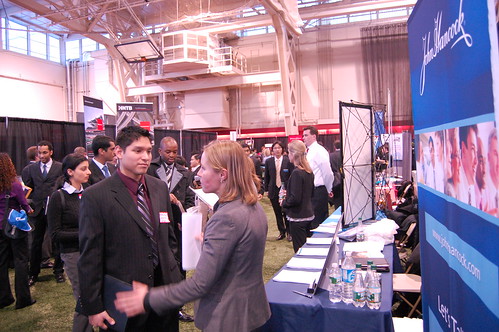
Bugger. I went through all that effort to print out and collate clips, buy and stuff folders, update and copy my resume, and practice my elevator pitch, and there was nothing there for me at the career fair last week. I know the industry's going through a rough redesign and identity crisis, but I had hoped there'd be at least a few more jobs tangentially related to journalism there. Even the PR and marketing segments were under-represented.
I suppose, on the bright side, that going to a career fair where there was little for me offered me a dress rehearsal of sorts - I got to interact with HR managers and recruiters without any of the pressure of an actual job being on the line.
Moral victories.
Flickr photo is mine.
Tuesday, February 03, 2009
The moat is gone.
This Thursday, I'm heading to my first career fair here at Northeastern. I've had my resume looked at a few times, I'm going to print up some clip folders to take with me, and I'm going home to get my suit tomorrow. But there's at least one thing I'm missing in my sell-yourself toolkit: the elevator pitch.
For each of my co-ops and internships, I've been able to use my clipbook as a moat of sorts. The people in charge take a look at what I've done, and only if they think I can handle the job do they call me in for an interview. By that point, I had one foot in the position already - I'm gathering that there aren't all that many applicants for the regionals at the Globe (although if these kids knew anything, that'd be top of their list). The interview itself was usually "tell me about yourself, tell me about your experience in journalism," and then, "this is what the job requires."
I've got to start from scratch now without that moat - the clipbook won't come into the equation until after first contact, and it's that first contact that is intimidating me a little bit now. I've never had to make an elevator pitch. I have absolutely no idea how I would go about it. "Hi, I'm Adam, I've been writing for newspapers for 7 years, and I've got a good handle on some social media"? That doesn't sound good at all.
How on Earth do I do this?
For each of my co-ops and internships, I've been able to use my clipbook as a moat of sorts. The people in charge take a look at what I've done, and only if they think I can handle the job do they call me in for an interview. By that point, I had one foot in the position already - I'm gathering that there aren't all that many applicants for the regionals at the Globe (although if these kids knew anything, that'd be top of their list). The interview itself was usually "tell me about yourself, tell me about your experience in journalism," and then, "this is what the job requires."
I've got to start from scratch now without that moat - the clipbook won't come into the equation until after first contact, and it's that first contact that is intimidating me a little bit now. I've never had to make an elevator pitch. I have absolutely no idea how I would go about it. "Hi, I'm Adam, I've been writing for newspapers for 7 years, and I've got a good handle on some social media"? That doesn't sound good at all.
How on Earth do I do this?
Subscribe to:
Posts (Atom)
